.png&w=3840&q=75)
Blog
Interview with Mr.Davutoğlu in Türkiiye
Publication Date: 20 September 2024 – 11:23
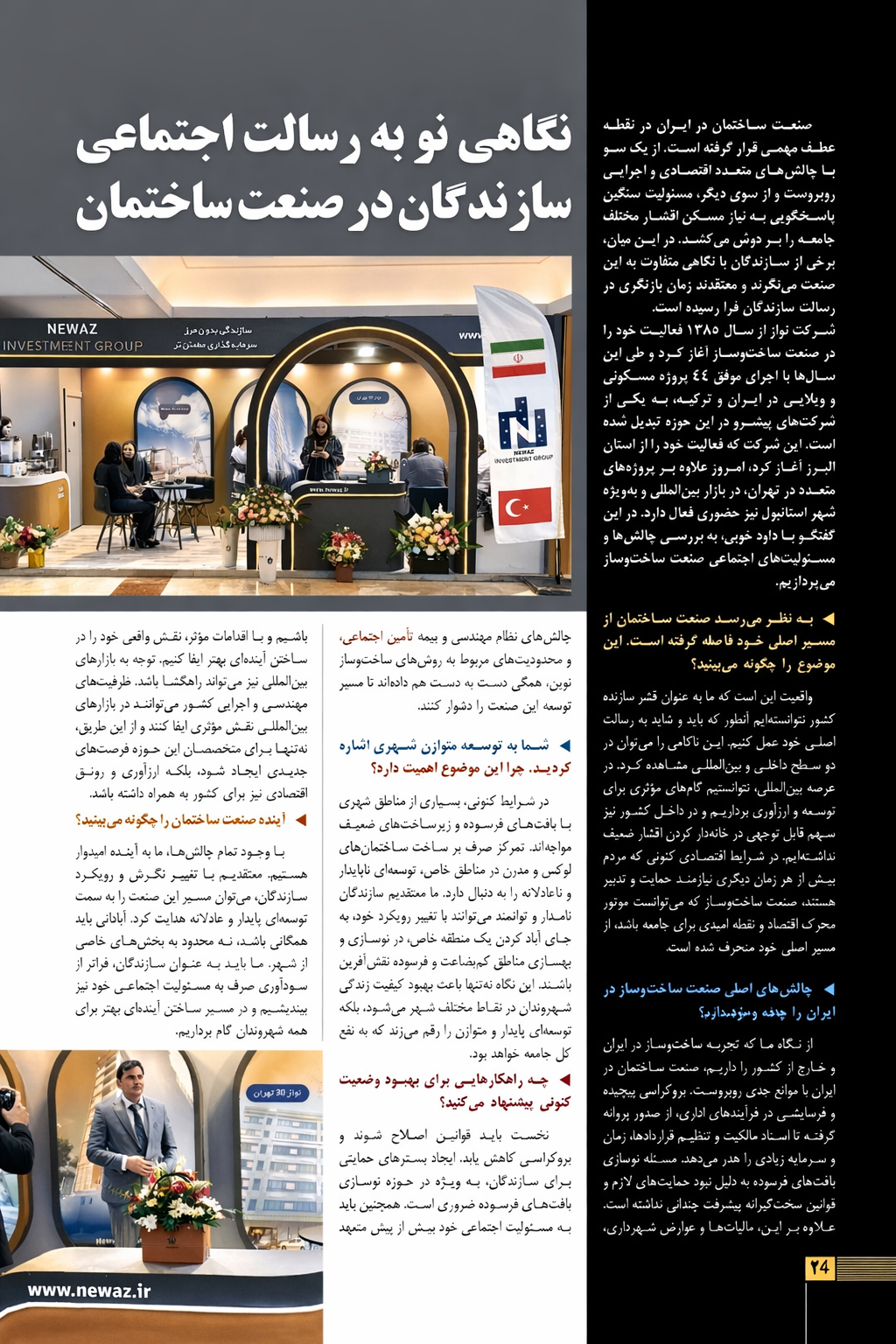
Davoud Khubi, CEO of Newaz Construction Company, in an interview with Donya-ye-Eghtesad
According to official statistics, the total size of the construction market in Turkey reached $14.9 billion in 2022. Experts in the real estate sector expected that after the end of the Covid-19 pandemic, the Turkish construction industry would experience renewed growth in 2023.
Long-term forecasts suggest that between 2023 and 2026 the industry will grow annually between 2.3% and 5%, supported by investments in transportation, renewable energy and tourism infrastructure projects.
To review the current state of this large market, Davoud Khubi, CEO of Newaz Construction, answered our questions.
Turkey’s construction industry is largely dominated by major companies operating under the supervision of the Ministry of Environment, Urbanization and Climate Change.
The Turkish government has created a very flexible environment for developers in both construction and property sales. In order to attract foreign investors, even special financial incentives are sometimes provided to real estate agents for selling properties to foreigners.
Once a construction license is obtained and the ground floor ceiling is completed, title deeds can already be issued and units can be sold legally, which significantly increases investor confidence.
Turkey’s economic strategy focuses strongly on tourism, exports and construction, and flexible policies have been implemented in these sectors to attract foreign capital.
Turkey has also recently developed a strong technology ecosystem. While the country had no unicorn startups in 2019, it now has five companies valued at over $1 billion. Among them, Trendyol has exceeded a valuation of $10 billion and became Turkey’s first decacorn.
According to official data, the Turkish real estate sector attracted $17.4 billion in net inflows in 2022.
As of 2024, about 1.2 million foreigners legally reside in Turkey, and approximately 4.5 million foreigners are employed in the country.
Foreign property ownership is fully permitted. Investors who purchase property worth more than $400,000 can obtain Turkish citizenship.
A residential project of about 40 units typically takes:
3 years in Iran
2 to 2.5 years in Turkey
This difference is mainly due to reduced bureaucracy and the use of modern construction technologies in Turkey.
From an entrepreneurial perspective, Turkey’s market is often considered more attractive due to its relative economic stability, foreign investment inflow and access to European and Middle Eastern markets, although Iran still has significant domestic potential